Summary
An interesting method by which I found out that people were cheating on my final exam.
Background
I use different versions of midterm examinations to discourage
cheating in my population biology class (~200 students). When the course
started, I used to do the same thing for the final exam, but it was a
little more complicated, because the final exam is administered by the
registrar's office, not by me and my teaching team.
At some point, somebody advised me not to bother with versions: the
registrar's office is supposed to be professional about administration,
and they
usually mix people who are taking different exams in the
same room, so I stopped bothering with different versions for the final
exam for a year or two. I do it again now, and you'll see why.
The incident
In the year in question, my exam was given in two separate
medium-sized rooms. My class was alone in these two rooms. I received a
report from the invigilators in Room 1 about suspicious behaviour. They
had warned a couple of students for acting strangely, and then warned
them again. They weren't prepared to say that they were sure that the
students were cheating, but wanted me to compare their answer slates. In
retrospect, they should have left the students alone until they were
ready to sign a complaint against them (or until they had cheated enough
to have it proved against them).
My response
The final is entirely multiple choice. I got the results files from
the scantron office. I figured that I wouldn't quite know what to do
with a comparison just between these two kids (unless the tests were
identical), and that it would be just about as easy (and far more
informative) to compare
everybody to
everybody else. It's
still kind of hard for me to get used to the fact that we have computers
now and can really do stuff like this. I calculated the number of
identical right answers and the number of identical wrong answers for
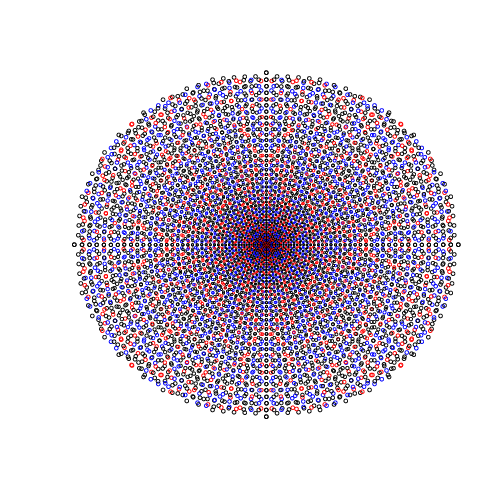
each pair of students (~18K pairs), and plotted it out.

The line corresponds to forty total shared answers (two students
having identical test papers). This did not happen. But there were four
points near the line that looked like clear outliers to me:

The follow up
I wasn't sure what to do next, but the registrar's office knew. They make
seating maps during exams. They didn't offer to help out, but I was allowed to go and examine the maps.
The results were amazing.
- All four of the identified pairs were seated adjacent (three
pairs were side by side, and the fourth pair had one student behind the
other). The probability that this might have happened by chance is
beyond ridiculous.
- None of the four identified pairs were seated in the room
where the alert invigilators hassled the pair of cheaters. This might
have been by chance, but I doubt it. Likely the invigilators in the
other room were visibly less alert.
I talked to the academic integrity office, and various experts, and
figured out that it really was impossible to be sure who had cheated in
the side-by-side pairs. I did put all 6 of them through a bit of an
ordeal, though, and at least half of them deserved it. I was also unable
to convict the person in front of the front-back pair (although it's
hard to see how that one would have worked without collusion). The
person in the back of the front-back pair denied all knowledge, but
received a zero for the exam grade plus a confidential, temporary
notation of my finding at the integrity office (the strongest punishment
I was allowed to give). They promised to fight it, but never did.
Postscript
I now use versioning, but I'm starting to discover that this does not
necessarily prevent cheating, either. I may have more adventures to
report, soon.
I definitely get the feeling that the person I caught cheated their
way through Mac. The initial response to my call was pretty relaxed.
They did get an F in my class (I couldn't give an automatic F for the
class, but the exam zero was sufficient). They retook the class and
passed, expunging the F, and graduating presumably with a clean record.
I have heard a lot of anecdotal reports of people dealing with
cheating informally (or not at all). It's kind of depressing. My
impression is that Mac has a cheating problem, and we need to fight
back.
Code
The code used to produce these plots in R is shown
here.